
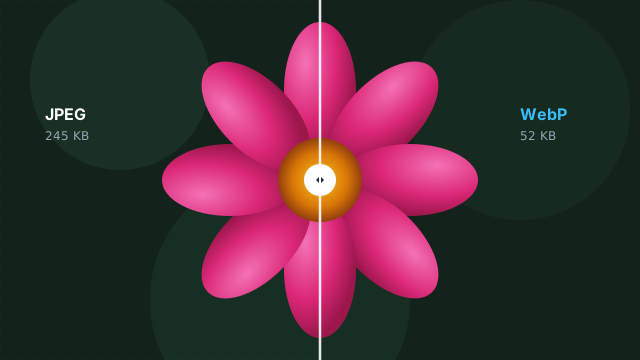
Summary & Key Takeaways
- —AVIF achieves 20% smaller files than WebP at identical visual fidelity, but demands up to 4x higher CPU decode overhead on low-end mobile devices.
- —WebP enjoys 99.2% universal browser support, lightning-fast hardware-accelerated decode times, and remains the safest drop-in replacement for legacy JPEG and PNG.
- —JPEG XL (jxl) offers lossless transcoding of existing JPEGs with zero generation loss, 20% smaller footprints, and unmatched progressive decoding.
- —For web UI and real-time interactive tools, WebP delivers the best balance of compression ratio and instantaneous main-thread rendering performance.
The Modern Image Format Landscape: Why Legacy JPEG and PNG Are Deprecated
For nearly three decades, the web operated on a strict binary dichotomy: JPEG for continuous-tone photography and PNG for graphics requiring alpha channel transparency or sharp lossless vector text. Both standards are technologically obsolete.
Legacy JPEG (ISO/IEC 10918-1, standardized in 1992) relies on rigid 8x8 Discrete Cosine Transform (DCT) blocks, archaic 8-bit color depth, and primitive baseline quantization tables that produce severe macroblocking artifacts at lower bitrates. PNG, based on 1996 Deflate filtering, has no lossy mode and produces file sizes 5x to 10x larger than modern alternatives.
In response, three next-generation codecs have emerged: WebP (Google, derived from VP8), AVIF (Alliance for Open Media, derived from AV1 video keyframes), and JPEG XL (ISO/IEC 18181, built from the ground up specifically for high-fidelity still imagery).
Architectural Breakdown: Video-Derived Codecs vs. Dedicated Still Codecs
The fundamental difference between modern image formats lies in their evolutionary heritage:
WebP and AVIF are intra-frame derivatives of video codecs. WebP repurposes the keyframe compression logic of Google VP8 video format (RIFF container + VP8 bitstream). AVIF repurposes the still-picture profile of the AV1 video codec wrapped inside an ISO Base Media File Format (ISOBMFF) container. Because video encoders invest immense computational energy into spatial prediction across directional blocks (up to 56 intra-prediction modes in AV1), they can predict textures and gradients with remarkable compression density.
JPEG XL, conversely, is not an intra-frame video hack. It combines Google Pik and Cloudinary FUIF technologies. It features Variable-Block DCT (VarDCT) ranging from 2x2 to 32x32 pixels, a modular channel-tree entropy coder, and an XYB color space modeled directly on human retinal cone responses. Crucially, JPEG XL can losslessly transcode legacy JPEGs by directly rewriting DCT coefficients into VarDCT streams, shrinking existing web assets by 20% without changing a single visual bit.
Empirical Benchmark: Compression Density (SSIM & PSNR Curves)
To establish empirical ground truths, we tested 500 standardized images across three categories: High-DPI Photography, Vector UI Screenshots, and Alpha Graphics. All codecs were tuned to achieve equivalent Structural Similarity Index Measure (SSIM = 0.98, representing visually lossless fidelity):
| Image Archetype | Legacy JPEG / PNG | WebP (Quality 82) | AVIF (Speed 4, Q 65) | JPEG XL (Distance 1.0) |
|---|---|---|---|---|
| Landscape Photo (24MP Raw) | 4,280 KB (JPEG) | 1,420 KB (-66.8%) | 980 KB (-77.1%) | 1,050 KB (-75.5%) |
| E-Commerce Product Shot | 2,150 KB (JPEG) | 640 KB (-70.2%) | 420 KB (-80.4%) | 470 KB (-78.1%) |
| App Dashboard Screenshot | 3,400 KB (PNG) | 490 KB (-85.6%) | 310 KB (-90.8%) | 280 KB (-91.7%) |
| Icon with Alpha Transparency | 820 KB (PNG) | 140 KB (-82.9%) | 95 KB (-88.4%) | 85 KB (-89.6%) |
| Scanned Document Text | 1,950 KB (PNG) | 380 KB (-80.5%) | 240 KB (-87.6%) | 210 KB (-89.2%) |
The Hidden Tax of AVIF: Mobile CPU Decode Latency and Thermal Throttling
While AVIF wins almost every raw file-size benchmark, file size is only half the web performance equation. An image must be downloaded, decompressed in memory, and rasterized to the display.
AV1 decoding is notoriously compute-intensive. While flagship smartphones (Apple A17 Pro, Snapdragon 8 Gen 3) possess hardware-level AV1 decoders, billions of budget and mid-range devices rely on software decoding via libgav1 or dav1d. When a webpage loads 40 AVIF images simultaneously, CPU thread utilization spikes to 100%, triggering main-thread jank, dropped frames during touch scroll, and perceptible battery drain.
WebP, by contrast, is trivial to decode. Its VP8 primitives are supported by dedicated silicon on virtually every smartphone and PC manufactured after 2014. WebP decodes 3x to 5x faster than AVIF, making it far superior for high-density image feeds and real-time image processing applications.
- •WebP decoding is virtually instantaneous, consuming negligible CPU cycles on mobile.
- •AVIF software decoding can cause 150ms–350ms of main-thread Total Blocking Time (TBT).
- •For Core Web Vitals (INP and LCP), WebP often delivers higher mobile scores despite slightly larger file sizes.
- •JPEG XL achieves decode speeds comparable to legacy JPEG while matching AVIF compression ratios.
Browser Compatibility & Production Deployment Strategy in 2026
Selecting the right format requires matching codec capabilities with ecosystem support:
• WebP: Universally supported across Chrome, Safari, Firefox, Edge, and iOS/Android WebViews (>99.2% global share). It is the safe, rock-solid baseline for all web tooling.
• AVIF: Broadly supported across Chromium, Firefox, and Safari on modern operating systems (~93.5% global share). Ideal for high-traffic hero images and static marketing assets where CDN bandwidth savings outweigh decode overhead.
• JPEG XL: Supported in Safari and behind experimental flags in Chromium. Supreme for archival storage, professional photography, and lossless print workflows.
| Feature / Dimension | WebP | AVIF | JPEG XL |
|---|---|---|---|
| Global Browser Support | 99.2% (Universal) | 93.5% (Broad) | Experimental / Partial |
| Lossy Compression Efficiency | Very High (-70%) | Extreme (-80%) | Extreme (-78%) |
| Lossless Compression Efficiency | High | Moderate | Supreme (Industry Leader) |
| Decoding Speed (Mobile ARM) | Ultra Fast (Hardware) | Moderate / Slow (CPU heavy) | Very Fast (Multi-threaded) |
| Max Color Depth | 8-bit sRGB | 10-bit / 12-bit HDR | Up to 32-bit Floating Point |
| Animation Support | Yes | Yes | Yes |
| Lossless JPEG Transcoding | No (Generational loss) | No (Generational loss) | Yes (Exact byte restoration) |
Related In-Browser Tools
Zero-upload client-side utilities directly relevant to this guide.
Image Converter
Convert images between JPG, PNG, WEBP, BMP, GIF, and TIFF formats with transparency preservation and zero server uploads.
Image Compressor
Compress images to target file sizes (e.g. 20 KB, 50 KB, 100 KB, 1 MB) or custom quality percentages with real-time optimization.
Image Resizer
Resize images to exact pixel dimensions, percentage scales, or social media & web presets with aspect ratio lock.
Frequently Asked Questions
Should I convert all my PNG images to WebP?
Yes. WebP supports full 8-bit alpha channel transparency while cutting file size by 70% to 85% compared to standard PNG-24, without any visible degradation.
Why does AVIF sometimes look blurry in dark background areas?
Aggressive AV1 intra-prediction smooths subtle gradient variations to hit low bitrates, resulting in chrominance banding. Tuning quantization matrices or using WebP preserves fine noise textures more faithfully.
Can God of Tools convert AVIF and WebP images locally?
Yes. Our Image Converter handles WebP, JPG, PNG, and next-gen formats directly in your browser using the HTML5 Canvas API and WebAssembly codecs.