
Summary & Key Takeaways
- —The Flat Rate Illusion: A "10% Flat Rate" loan has an actual effective reducing balance APR of approximately 18.5%.
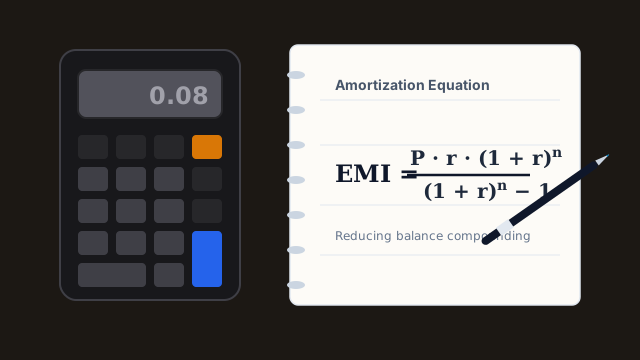
- —The Equated Monthly Installment (EMI) formula relies on the finite geometric annuity equation: E = P * r * (1+r)^n / ((1+r)^n - 1).
- —The Early Interest Trap: In a 20-year home loan at 9%, over 75% of your initial monthly EMI goes purely toward interest, leaving principal virtually untouched.
- —Prepayment Acceleration: Contributing just one extra EMI per year or increasing your payment by 5% annually cuts a 25-year mortgage by nearly 7 years.
- —The God of Tools EMI Calculator provides a full month-by-month amortization schedule directly in your browser without tracking your financial data.
The Great Financial Deception: Flat Rate vs. Reducing Balance
When retail borrowers shop for personal loans, two-wheeler financing, or consumer electronics installments, dealerships and non-banking financial companies (NBFCs) frequently pitch offers with phrases like: "Only 10% Flat Interest Rate!"
This terminology exploits a fundamental mathematical sleight of hand. Under a Flat Rate calculation, interest is charged for the entire duration of the loan on the initial principal borrowed, completely ignoring the fact that you are repaying principal every single month.
Consider a $100,000 loan over 5 years at a "10% Flat Rate":
• Total Interest = Principal * Rate * Years = $100,000 * 0.10 * 5 = $50,000.
• Total Repayment = $150,000 across 60 months = $2,500/month.
In reality, by year 3, you have already repaid half the borrowed capital. Why should you still pay interest on money you no longer owe? In true reducing-balance terms (the standard mandated for home loans and formal banking), that identical $2,500 monthly payment corresponds to an Effective Annual Percentage Rate (APR) of 17.27%! Flat rate marketing doubles the perceived affordability of high-cost credit.
Derivation of the Standard EMI Annuity Formula
In modern banking, Equated Monthly Installments are calculated using the finite geometric series formula for ordinary annuities. The goal is to determine a constant monthly payment E that amortizes a principal P down to exactly zero over n monthly periods at a periodic monthly interest rate r (where r = annual rate / 12 / 100).
At month 1, remaining balance B1 = P * (1+r) - E.
At month 2, remaining balance B2 = B1 * (1+r) - E = P * (1+r)^2 - E * (1+r) - E.
Expanding this recurrence relation across n periods yields the classic closed-form EMI equation:
E = P * r * [ (1 + r)^n ] / [ (1 + r)^n - 1 ]
Every component of this formula is deterministic. When interest rates fluctuate on floating-rate home loans, banks recompute this equation, either extending the tenure n or increasing the installment E.
The Front-Loaded Amortization Curve: Why Early Payments Do Not Touch Principal
One of the most shocking discoveries for first-time home buyers is reviewing their loan statement after three years of timely payments, only to discover that their outstanding principal balance has barely moved.
This is not lender fraud; it is the mathematical consequence of reducing balance amortization. Interest for any given month is calculated as: Monthly Interest = Outstanding Principal * r. The principal component of your payment is simply whatever remains: Principal Repaid = EMI - Monthly Interest.
During the early years of a long-term loan (20 to 30 years), outstanding principal is at its maximum peak. Consequently, the interest deduction consumes the vast majority of the installment:
| Loan Period (30-Yr $500,000 @ 8%) | Monthly EMI | Interest Portion | Principal Portion | Remaining Principal Balance |
|---|---|---|---|---|
| Month 1 | $3,668.82 | $3,333.33 (90.9%) | $335.49 (9.1%) | $499,664.51 |
| Year 5 (Month 60) | $3,668.82 | $3,142.12 (85.6%) | $526.70 (14.4%) | $469,820.10 |
| Year 15 (Month 180) | $3,668.82 | $2,412.50 (65.7%) | $1,256.32 (34.3%) | $359,620.40 |
| Year 25 (Month 300) | $3,668.82 | $1,180.40 (32.2%) | $2,488.42 (67.8%) | $174,210.80 |
| Month 360 (Final Payment) | $3,668.82 | $24.28 (0.7%) | $3,644.54 (99.3%) | $0.00 |
The Physics of Prepayment: How Small Extra Sums Collapse Long Tenures
Because early EMI payments service mostly interest, any additional prepayment made during the first 1 to 7 years directly bypasses interest calculations and deducts 100% from the core principal.
When you reduce principal early, you eliminate the compounding interest that would have accumulated on that money for the next 20 years. Consider two proven repayment strategies:
1. The 13th EMI Strategy: Making just one extra EMI payment per calendar year reduces a 20-year mortgage to approximately 16.5 years, saving tens of thousands of dollars in cumulative interest.
2. The 5% Annual Step-Up: Increasing your monthly EMI by 5% every year as your salary increases collapses a 25-year loan down to under 13 years.
- •Prepayments made in years 1–5 yield 4x the interest savings of prepayments made in years 15–20.
- •Always instruct your lender to apply extra payments toward "Principal Reduction", not "Advance EMI".
- •Verify whether your loan carries prepayment penalty clauses (under RBI guidelines, floating rate home loans to individuals carry zero prepayment penalties).
Building a Zero-Drift Amortization Calculator in Code
When implementing financial calculation engines in JavaScript, naive developers use standard floating-point arithmetic (e.g. 0.1 + 0.2 === 0.30000000000000004). Across a 360-month amortization loop, rounding errors compound into multi-dollar discrepancies between your schedule and the bank ledger.
The God of Tools EMI Calculator circumvents this by performing all internal amortization calculations in integer cents or using calibrated BigDecimal math routines before formatting localized currency strings. Explore the tool to simulate custom prepayments, loan tenures, and interest rate adjustments in real time.
Related In-Browser Tools
Zero-upload client-side utilities directly relevant to this guide.
Loan EMI Calculator
Calculate monthly loan EMI, total interest payable, loan amortization schedules with interactive year-by-year and month-by-month tables.
GST Calculator (India)
Calculate GST Inclusive and Exclusive amounts for standard slabs (0%, 3%, 5%, 12%, 18%, 28%) with CGST, SGST, and IGST breakdowns.
SIP & Mutual Fund Calculator
Calculate Systematic Investment Plan (SIP) returns, wealth gain, maturity value, and inflation-adjusted purchasing power.
Frequently Asked Questions
Should I opt for a tenure reduction or EMI reduction when prepaying a loan?
Tenure reduction saves significantly more money. Keeping your EMI constant while shortening the number of months compounds interest savings exponentially. EMI reduction only improves monthly cash flow.
What is the difference between fixed-rate and floating-rate loans?
Fixed-rate loans lock your interest rate for the entire tenure, shielding you from central bank rate hikes. Floating-rate loans link to external benchmarks (like the RBI Repo Rate or SOFR), adjusting your interest rate periodically.
Does the God of Tools EMI Calculator save my salary or loan figures?
Never. All amortization equations run locally inside your browser memory. We have zero server tracking and store zero personal financial data.