
Summary & Key Takeaways
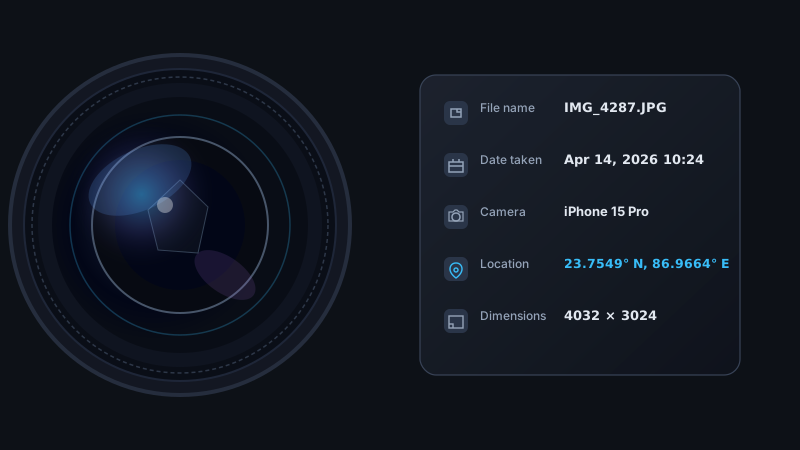
- —Every smartphone capture embeds Exchangeable Image File Format (EXIF) metadata including GPS latitude/longitude accurate to within 3 meters.
- —EXIF headers record unique hardware identifiers: camera sensor serials, lens IDs, and phone model designations that persist across anonymous postings.
- —The Embedded Thumbnail Vulnerability: Cropping or censoring a photo in basic editors often leaves the original, uncensored full-frame thumbnail intact inside the header.
- —While major social networks (Twitter, Instagram) strip EXIF on upload, direct transfers via email, AirDrop, Discord, or web forms send raw unredacted telemetry.
- —God of Tools provides an in-browser EXIF Inspector and Sanitizer that scrubs metadata markers at the byte level without cloud exposure.
What Is EXIF Data and How Does It Get Embedded in Your Photos?
Exchangeable Image File Format (EXIF) is an international standard established by JEITA (Japan Electronic and Information Technology Industries Association) in 1995. It specifies how digital cameras and mobile devices attach technical telemetry to raster image files (JPEG, TIFF, HEIC, and WebP).
In a standard JPEG stream, the file begins with a 2-byte Start of Image (SOI) marker: 0xFF 0xD8. Immediately following this marker, the camera operating system inserts an Application Marker 1 (APP1: 0xFF 0xE1). Inside this APP1 segment resides a complete TIFF-structured header containing dozens of Image File Directories (IFDs).
Originally designed to help photo organizers catalog shutter speed, f-stop, focal length, and white balance, EXIF in the smartphone era has evolved into an unintended high-precision surveillance ledger.
The Dangerous Telemetry Surfaces: What You Are Leaking
When you snap a casual photo in your living room or workplace, your device records dozens of sensitive telemetry tags:
• High-Precision GPS Coordinates: The GPS IFD (Tag 0x8825) records GPSLatitude, GPSLongitude, GPSAltitude, and even GPSImgDirection (the exact compass direction your phone was pointing when you pressed the shutter). This pinpoints your physical location down to an exact window or desk.
• Device & Hardware Fingerprinting: Tags 0x010F (Make), 0x0110 (Model), and proprietary MakerNote tags frequently record camera sensor serial numbers, internal device firmware builds, and unique internal IDs.
• Exact Temporal Timestamps: Tag 0x9003 (DateTimeOriginal) records the millisecond timestamp according to the device internal atomic clock, correlating your physical presence with external timelines.
• Computational Post-Processing Records: Modern computational photography tags record facial detection bounding boxes, HDR blend ratios, and portrait depth maps.
Social Media vs. Direct Transfer: The Sanitization Myth
A dangerous misconception among non-technical users is that "the internet automatically deletes EXIF data." This is only partially true for specific closed-loop social networks:
Platforms like Meta (Facebook, Instagram) and X (Twitter) re-encode uploaded images through their own compression pipelines, stripping public EXIF metadata. However, they extract and log that geographical metadata into their internal profiling databases prior to stripping it.
More critically, direct communication channels perform zero sanitization:
| Sharing Channel | EXIF Scrubbed? | GPS Exposure Risk | Privacy Implication |
|---|---|---|---|
| Direct Email Attachment | No (100% Intact) | Critical | Recipient can extract exact home/office GPS coordinates |
| AirDrop / Nearby Share | No (100% Intact) | Critical | Full hardware serials and geolocation transferred |
| Discord / Telegram (as File) | No (100% Intact) | Critical | Raw binaries preserved without recompression |
| Real Estate / Job Web Portals | Rarely Scrubbed | High | Uploaded ID cards or property photos expose private telemetry |
| WhatsApp / iMessage (standard) | Yes (Scrubbed on re-encode) | Low | Platform strips metadata during aggressive lossy recompression |
How Forensic Sanitization Works: Byte-Level Header Stripping
Sanitizing an image does not require recompressing the visual pixels (which causes generational quality degradation). Instead, clean forensic sanitization operates at the byte stream level:
1. Marker Scanning: The binary parser walks the JPEG byte sequence looking for 0xFF markers.
2. APP Segment Identification: When an APP1 marker (0xFF 0xE1) is encountered with the header "Exif\0\0", the parser measures the 2-byte segment length.
3. Slicing the Stream: The entire APP1 byte slice—including all TIFF IFDs, GPS tables, and MakerNotes—is excised from the buffer.
4. Reconstruction: The remaining Start of Image (0xFF 0xD8), quantization tables (DQT: 0xFF 0xDB), Huffman tables (DHT: 0xFF 0xC4), and Start of Scan (SOS: 0xFF 0xDA) frames are concatenated into a pristine sanitized JPEG.
The resulting file contains 100% identical pixel data, bit for bit, but contains zero traces of your camera model, location, or shooting parameters.
Verifying Clean Headers in Chrome DevTools or Terminal
You can verify image sanitization in seconds using standard command-line tools or web developer consoles:
On macOS and Linux, run: exiftool -all= image.jpg or view tags with exiftool -GPS:all image.jpg.
Alternatively, drop your photo into the God of Tools Image Metadata Viewer. Our engine reads every IFD0, ExifIFD, GPSIFD, and InteroperabilityIFD tag entirely in local browser memory, displaying every embedded coordinate on an interactive visual map while confirming whether thumbnail markers exist.
Related In-Browser Tools
Zero-upload client-side utilities directly relevant to this guide.
Image Metadata
Inspect detailed EXIF, camera, lens, color profile, and GPS location metadata, or strip all metadata for privacy.
Image Cropper
Crop images visually with freeform bounding boxes, standard aspect ratios (1:1, 4:3, 16:9, 3:2), and 90-degree rotation.
Image Compressor
Compress images to target file sizes (e.g. 20 KB, 50 KB, 100 KB, 1 MB) or custom quality percentages with real-time optimization.
Frequently Asked Questions
Does stripping EXIF data lower the visual quality of my photo?
Not by a single pixel. EXIF metadata is stored in auxiliary header segments separate from the image entropy stream. Stripping it is a 100% lossless operation that makes the file smaller and safer.
Can GPS coordinates be recovered after an image is sanitized?
No. Once the APP1 EXIF segment is stripped from the binary stream, the coordinate bytes are permanently deleted and mathematically irrecoverable.
Does God of Tools upload my photos to inspect EXIF tags?
Never. Our EXIF Inspector parses binary ArrayBuffers directly inside your browser tab using pure JavaScript. Your photos never touch our servers.